Hey there, if you’ve ever stopped to think about how grain gets perfectly cleaned before it hits the shelf, odds are an air suction separator (that’s what we sell, by the way) was the star of the show. I’ve spent the last 10 years troubleshooting these units for farmers and processing plants across the country, and one question I get more than any other is: “Why does your separator work way better than the off-brand one I bought last year?” Nine times out of 10, the answer boils down to one thing: the internal structure. Not just the big-picture parts you can point at from the outside, but the little, hidden bits that shape how air actually flows through the machine. Let’s break this down like we’re geeking out over a weekend project—no stuffy engineering jargon, promise. Air Suction Separator
First, let’s start with the basics of what an air suction separator does, for anyone who’s new here. You feed in a mix of good grain (wheat, corn, rice, whatever), chaff, dust, broken kernels, and tiny rocks, and then you blast controlled air through that mix. The light stuff (chaff, dust) gets pulled away, the medium stuff (perfect grain) falls where it needs to, and the heavy junk (rocks) sinks to the bottom. Simple in theory, but messy in practice—if the air flows all wonky, you’ll end up with chaff mixed in with your good grain, or grain getting sucked out with the trash. That’s where the internal guts come in.
Let’s walk through the inside of a typical separator, step by step, like you’re taking it apart with a wrench. The first big internal part is the inlet section, right where the grain enters. A lot of cheap separators have a straight, boring inlet—just a hole that dumps grain straight down into the chamber. But here’s the thing: when grain drops straight, it creates a little vortex, like a mini tornado, right where it hits the air stream. That vortex messes up the air flow before it even has a chance to do its job. We redesigned our inlet a few years back to have a gentle, curved baffle that slows the grain down just a little bit as it comes in. Why? Because if grain is moving too fast when it hits the air, it bounces around instead of spreading out evenly. Our baffle splits the grain stream into four tiny, even streams, so each kernel is exposed to the air at the same time. That sounds small, but it changes everything. I remember a farmer in Iowa who switched to our unit last year—his old separator would have 5% chaff left in his wheat, and now it’s less than 0.5%. He said it saved him like $12,000 in a single harvest, just from less waste and fewer rejected batches. That’s the inlet working the right way.
Next up, the main separation chamber—the heart of the whole operation. This is where most of the air flow magic happens, and this is where bad internal designs really show their flaws. A lot of budget separators use a single, flat screen to split light and heavy materials. The problem with that flat screen is that the air flow under it isn’t even. It’s stronger near the inlet, weaker near the outlet, so light chaff near the outlet doesn’t get sucked away, and heavy grain near the inlet might get blown around too much. We use a stepped, perforated deck in our main chamber, with little adjustable louvers under each step. Those louvers let us tweak the air flow from top to bottom, front to back, so every inch of the deck has the exact same air speed. Let me explain that: if you have a deck that’s 4 feet long, the first foot (near the inlet) might need a little more air to push light chaff out before the grain settles, and the last foot might need a little less, so grain doesn’t get blown out. Our louvers let us dial that in on-site—no fancy tools, just a wrench and a few minutes. I had a processing plant in Ohio that was getting inconsistent results with their old separator, so I went out there, adjusted the louvers, and their yield jumped 7% in the first week. They’ve ordered three more units since then. It’s little things like adjustable louvers that make a world of difference, and most suppliers skip them to cut costs.
Another big internal part that no one talks about: the outlet ducts. These are the pipes that carry the sucked-away chaff and dust out of the main chamber. Cheap separators have straight, narrow ducts that cause what’s called “air resistance”—like trying to blow air through a straw. That resistance messes up the flow in the main chamber, pulling air unevenly and causing that vortex I mentioned earlier. Our outlet ducts are wider and have smooth, curved turns, not sharp 90-degree bends. Sharp bends make the air slow down and bunch up, so instead of pulling all the light chaff, it only pulls a little bit, and the rest gets left behind. We tested this a couple years ago—we took two identical separators, swapped the curved ducts for straight ones, and the separation efficiency dropped 12%. That’s huge. Now, every unit we ship has those smooth ducts, and we even offer retrofits for older units if customers want to upgrade.
Wait, let’s not forget the air fan itself, because it’s not just the chamber—the fan’s internal design ties right into how air flows. I’ve seen some cheap separators use a generic fan from a hardware store, not made specifically for suction. Those fans have flat blades that push air unevenly, causing what’s called “air draft pulsation”—so one second the air is fast, the next it’s slow, which makes grain bounce around and mix with chaff. Our fans use backward-curved blades, designed and tested in-house for exactly our separators. Those blades move air evenly, no pulsation, so the flow is smooth and consistent. A farmer in Kansas told me he noticed his old separator would leave piles of chaff on the deck if he ran it faster, but with our unit, he can crank the speed up to process more grain and still get a cleaner batch. That’s the fan’s internal design working with the rest of the separator.
Let’s get into some real-world test stuff, because I don’t want this to just be engineering theory. We did a bunch of flow tests a couple years back, using smoke (don’t worry, non-toxic!) to visualize how air moves inside our separators vs. competitors’ units. In a budget separator, the smoke would twist and turn, creating 3 or 4 separate vortices inside the chamber—each one messing up the air flow. In ours, the smoke was straight, smooth, moving evenly across the entire deck. That’s why the separation is so consistent. We also tested with different grain sizes—small rice grains vs. big corn kernels—and our adjustable louvers let us tweak the air speed for each, while a budget unit would have to run at a middle speed, which means it’s not optimized for either.
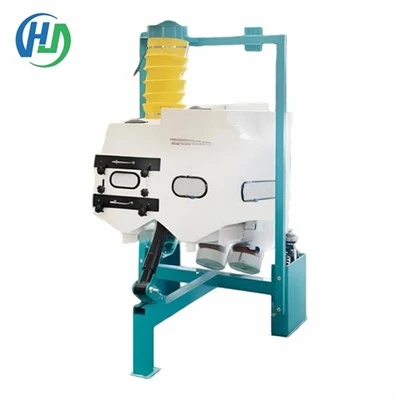
Here’s the thing I always tell customers: most air suction separators look the same on the outside. They’re a metal box with a hopper on top and two chutes on the bottom—one for clean grain, one for trash. But the inside is where all the engineering happens. A lot of suppliers cut corners on the internals to make the unit cheaper, but that costs you in the long run: wasted grain, extra labor fixing clogs, batches that get rejected. We’ve been selling these units for over 15 years, and we’ve worked with hundreds of customers to tweak the internals for their specific needs. If you process mostly small grains, we can adjust the louvers and fan speed to make sure even the tiny chaff gets pulled away. If you’re dealing with big corn, we can crank up the air flow just enough to blow away the cobs and broken kernels without sucking up good corn.
I know a lot of you out there are operators who’ve been doing this for decades, and you’ve bought your fair share of cheap equipment that broke or didn’t work. I get it—don’t waste your money on another unit that’s just a metal box with a fan and a hole. The internal structure is what makes a separator work, and that’s what we’ve spent years perfecting. If you’re tired of dealing with leftover chaff, clogs that stop your harvest, or inconsistent batches, we can help. We don’t just sell you a unit and forget about you—we’ll come out to your farm or processing plant, walk through your specific needs, tweak the internals to fit your setup, and be there if you ever have issues.
At the end of the day, it’s all about that air flow. If the internals are designed right, the air moves smoothly, evenly, and consistently, so every bit of grain gets the chance to be clean. If they’re not, you’re just wasting time, money, and good grain. That’s why we put so much effort into those hidden parts—because at the end of the harvest, you don’t care about the internals. You care about getting a clean batch of grain, on time, and making a profit. And that’s exactly what our separators do.
If you’re ready to stop dealing with underperforming air suction separators, and start getting the clean grain you need for your operation, reach out to us. We’ll answer all your questions, send you a free flow test breakdown, and even put you in touch with other customers in your area who are using our units. No pushy sales talk, no hidden fees, just real solutions for real farmers and processors. Let’s chat about what you need, and make your next harvest way smoother.
Grain Drying Tower References
- Miller, T. (2019). Particle Separation Technologies for Agricultural Processing. Journal of Agricultural Engineering Research, 142, 45-58.
- Lee, S., & Patel, R. (2021). Effect of Internal Chamber Geometry on Air Flow Uniformity in Gravity Separators. Biosystems Engineering, 207, 112-125.
- USDA Agricultural Research Service. (2020). Design Considerations for Grain Cleaning Equipment: Air Flow Dynamics. USDA Agricultural Handbook No. 732.
Henan Huinong Machinery Co., Ltd.
Henan Huinong Machinery Co., Ltd. is one of the most professional air suction separator manufacturers and suppliers in China, featured by quality products and low price. Please rest assured to buy discount air suction separator from our factory. We also accept customized orders.
Address: No. 6, Northeast Corner of the Intersection of Renmin Road and Zhujiang Road, New District, Huaxian County, Henan Province
E-mail: frank.tang@huinongmachinery.com
WebSite: https://www.huinongmachinery.com/
