If you’ve ever hauled a trailer for work, recreation, or moving, you’ve probably glanced at the small, rectangular (or sometimes circular) reflectors bolted to its sides, rear, and even front edges. You might’ve wondered—especially if your trailer’s paint job is faded, mismatched, or you want a custom look for a classic camper, utility trailer, or construction unit—can I paint my trailer reflectors? The short answer is: you can, but it’s not as simple as grabbing a random can of spray paint and dabbing them on. As a supplier of trailer reflectors for more than 12 years, I’ve heard this question dozens of times, from first-time trailer owners who want a cohesive aesthetic to fleet managers testing cost-effective custom branding. Today, I’m breaking down the science, the do’s and don’ts, and the best ways to paint reflectors without ruining their ability to keep you safe on the road. Trailer Reflector
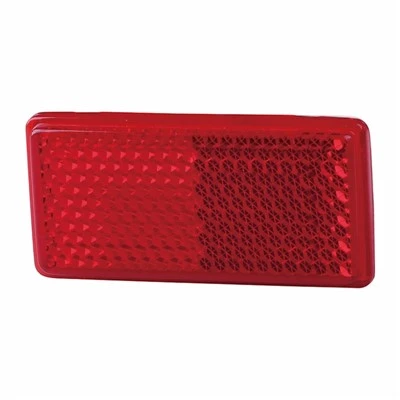
First, let’s talk about why trailer reflectors matter in the first place—because skipping that context makes the “can I paint” question feel abstract. Reflectors work by retroreflection: they bounce light directly back to its source, unlike mirrors which scatter light or regular paint which absorbs it. When a car’s headlights hit a trailer reflector at night, that light travels through a tiny, prismatic grid inside the reflector, hits a mirrored surface, and bounces straight back to the driver. That’s why you can spot a trailer 1,000 feet away in the dark, even if the trailer’s own lights are off. Federal and state regulations in the U.S. (and similar rules globally) specify reflector size, placement, and brightness levels—so any modification has to not compromise that retroreflective property.
Now, why would someone want to paint their reflectors? Aesthetic is the top reason. Classic aluminum utility trailers or vintage campers often have mismatched, faded reflectors that stick out like a sore thumb. Some trailer owners paint their reflectors to match their trailer’s body color, so the unit looks intentional instead of utilitarian. Others do it for small business branding: a landscaping company might paint their side reflectors green to match their trucks, or a food trailer might add a subtle logo hue to their rear reflectors. There’s also the practical side: if your reflectors are chipped or scratched, a thin layer of matching paint can cover small imperfections without replacing them entirely—though replacement is always better for large damage.
But here’s where most people go wrong: they don’t know that not all paint works on retroreflector materials. Most trailer reflectors are made with a polycarbonate (plastic) base and a layer of microprisms or glass beads glued to the surface. That top layer is the retroreflective part. If you paint directly on that glass bead or microprism layer, you’re sealing the light pathway—so when headlights hit the reflector, the light can’t reach the mirrored backing, and the reflector becomes useless. I’ve had customers bring in reflectors they tried to paint with regular acrylic spray, and the result was a dull, matte spot that barely registered light at 50 feet. That’s a safety hazard, plain and simple.
So, is there a way to paint reflectors without ruining their function? The key is to cover only the edges or outer areas, not the retroreflective surface itself. Or, if you want a full-color look, you can use a translucent paint that lets light pass through to the microprisms. Wait—translucent, not transparent. Let me explain: transparent paint would let light through, but it doesn’t have the pigment to stand out. For example, a red trailer’s reflectors are red because the pigment absorbs blue and green light, reflecting red back to the driver. A translucent red paint would let the headlight’s white light pass through to the microprisms, then reflect back red, so the reflector still works. A opaque red paint would block the light entirely. That’s a critical distinction.
Let’s walk through a step-by-step process that’s been tested by our team here at the trailer reflector supplier. First, assess the condition of your reflectors. If they’re cracked, scratched deep enough to expose the base plastic, or faded beyond recognition, skip painting and order a set of replacement reflectors. Even a good paint job can’t fix a damaged retroreflective layer. If they’re intact, with only minor surface scuffs or you want to match your trailer’s color on the outer trim, that’s when painting is an option.
Next, gather the right supplies. You’ll need: 1) Translucent spray paint (not acrylic, not latex, not regular glossy paint—look for brands that advertise “translucent for plastic” or “retroreflective-compatible”). We recommend brands like Rust-Oleum’s Translucent Enamel, which works on polycarbonate surfaces and doesn’t clog microprisms. 2) Masking tape and newsprint or a drop cloth to cover the retroreflective center of the reflector. This is non-negotiable: you want to leave the middle of the reflector bare, where the light bounces. Only paint the border, the edges that sit flush to the trailer, or small decorative accents if you’re doing a custom design. 3) Fine-grit sandpaper (220-grit) to scuff the surface of the reflector’s plastic base—this helps the paint adhere. Don’t sand the microprism layer; that’s the part you’re leaving bare. 4) Isopropyl alcohol to clean the surface, so the paint sticks evenly.
Now, the application steps. First, clean the reflector thoroughly with isopropyl alcohol to remove grease, road grime, or wax. Let it dry completely. Then, mask off the retroreflective center: measure the size of your reflector, and apply tape around a 1/4-inch border if you’re painting the edges, or a thin stripe along the trim. Make sure the tape is pressed down firmly so paint doesn’t seep under. Lightly scuff the unmasked plastic base with the 220-grit sandpaper—just enough to create a slight texture, don’t sand through to the microprisms. Wipe away any dust with another alcohol wipe.
Then, apply the translucent paint in thin, even coats, holding the can 8 to 10 inches away from the reflector. Thick coats will run or clog the edges of the tape, and too much paint can seep into the microprism layer if your masking isn’t perfect. Apply 2 to 3 light coats, waiting 15 minutes between each, until the color is even. Let the final coat dry for 24 hours before removing the masking tape. When you peel off the tape, make sure it pulls away cleanly—if any paint sticks, use a small craft knife to trim it, but take care not to scratch the retroreflective surface.
Wait, but what if you want to paint the entire reflector, not just the edges? Is that ever a good idea? In most cases, no—because you’ll need to use a retroreflective paint, which is a specialized product that has its own microprisms suspended in the paint. Regular paint doesn’t have those, so it won’t bounce light back. We do offer custom retroreflective paint for fleet customers who want full-color reflectors, but that’s a professional-grade product, not something you can pick up at a hardware store. If you’re a small business owner with a fleet of 5 or more trailers, that’s a better option than DIY painting, because it meets FMCSA (Federal Motor Carrier Safety Administration) requirements for visibility.
Speaking of regulations, it’s important to note that some states have laws against modifying trailer reflectors. For example, California requires all rear reflectors to be unobstructed and retroreflective at 1,000 feet. If you paint too much of the reflector and it fails that test, you could get a ticket. We always tell customers to check their state’s DOT rules before modifying any trailer lighting or reflectors.
Now, let’s address the common myths I hear as a reflector supplier. First, “any paint will work as long as it’s thin.” That’s not true—even a thin layer of opaque acrylic paint will block light. I tested this last year on a set of old reflectors: I painted one with translucent red, one with regular red acrylic, and one with no paint. The translucent one worked, the regular one was barely visible at 50 feet, and the bare one was perfect. Second, “you can paint reflectors to match your trailer’s color for a uniform look.” This is only true if you’re leaving the retroreflective center exposed. If you paint the entire surface, the only way it works is with specialized retroreflective paint. Third, “scratched reflectors can be fixed with paint.” If the scratch is on the plastic base, yes—if it’s on the microprism layer, no. The microprisms are tiny, glass-like structures that break easily, so a deep scratch renders the reflector useless, no matter how much paint you add.
So, when should you just replace your reflectors instead of painting? If your reflectors are more than 10 years old, even if they look intact, the retroreflective material degrades over time from sun exposure, road salt, and temperature changes. A 10-year-old reflector, even if you paint it, will never be as bright as a new one. If you’re hauling heavy loads or driving on busy highways at night, a new set of reflectors is a better investment than a DIY paint job. We stock a wide range of replacement reflectors, from standard rectangular ones for utility trailers to round ones for campers, all compliant with FMCSA and state regulations.
At the end of the day, the answer to “Can I paint my trailer reflectors?” is: yes, if you do it correctly, and only if you’re willing to keep the retroreflective core exposed. It’s a great way to spruce up a small part of your trailer without a full paint job, but it’s not a one-size-fits-all fix. For anyone who wants a custom look or to repair damaged reflectors, we’re here to help—whether you’re a weekend warrior with a single camper, a small business owner with a fleet of work trailers, or a hobbyist restoring a classic antique trailer.

If you’re considering painting your reflectors and want to make sure you’re doing it safely, or if you’re ready to swap out old, faulty reflectors for new ones, don’t hesitate to reach out to our team. We can answer all your questions about compatible paints, reflector sizes, and compliance with local DOT rules.
Truck Reflector References:
- U.S. Department of Transportation Federal Motor Carrier Safety Administration. (2022). Lighting and Reflective Devices for Commercial Motor Vehicles.
- Society of Automotive Engineers. (2019). Retroreflective Materials for Automotive Safety Applications.
- Trailer Manufacturers Association. (2021). Maintenance and Modification Guidelines for Trailer Lighting and Reflectors.
- American National Standards Institute. (2020). Safety Standards for Recreational Trailer Reflectors.
Ningbo Baixuejia Reflector Co., Ltd.
Ningbo Baixuejia Reflector Co., Ltd. is one of the most professional trailer reflector manufacturers and suppliers in China. We are committed to providing high quality automotive parts and reflective safety products with competitive price. Please feel free to wholesale advanced trailer reflector made in China here from our factory. Also, quotation is available.
Address: No.10-12, Southwest Road, Shidong Village, Guanhaiwei Town, Cixi City, Zhejiang Province
E-mail: bxjreflector@cnbxj.cn
WebSite: https://www.bxjreflector.com/
