Hey there, folks! I’m a supplier of metal bandsaw blades, and I often get asked about the differences between hook – tooth and flat – tooth metal bandsaw blades. So, I thought I’d take a few minutes to break it down for you. Metal Bandsaw Blade
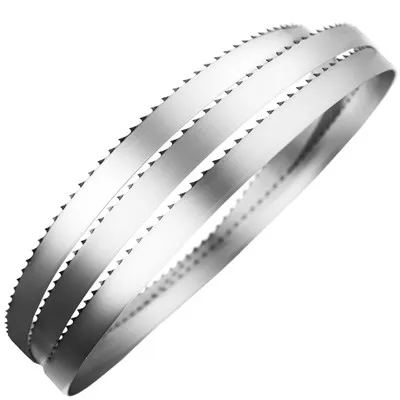
Let’s start with hook – tooth metal bandsaw blades. These blades are pretty unique in the way they’re designed. The hook – shaped teeth are angled forward, which gives them a really aggressive cutting action. When you’re using a hook – tooth blade, it’s like having a little army of tiny cutting warriors going at your metal. They dig into the material quickly and efficiently, making short work of thick and tough metals.
One of the big advantages of hook – tooth blades is their speed. They can cut through metals like steel, stainless steel, and even some alloys at a much faster rate compared to flat – tooth blades. This is great for high – volume production environments where time is money. For example, if you’re running a factory that produces a large number of metal parts every day, a hook – tooth blade can help you meet your production targets faster.
Another benefit of hook – tooth blades is their ability to handle tough materials. The forward – angled teeth are better at gripping and cutting through hard metals. They can slice through work – hardened steel without getting dull too quickly. However, this aggressive cutting action also has its downsides. Hook – tooth blades can sometimes produce a rougher cut surface. The teeth dig in so hard that they can leave behind small ridges and marks on the metal. This might not be a big deal if the final product doesn’t require a super smooth finish, but it can be a problem for applications where surface quality is crucial.
Now, let’s talk about flat – tooth metal bandsaw blades. These blades have teeth that are perpendicular to the blade’s edge. The flat – tooth design gives them a more controlled and precise cutting action. Instead of digging in aggressively like hook – tooth blades, flat – tooth blades shave off the metal in small, even layers.
The main advantage of flat – tooth blades is the quality of the cut. They produce a much smoother surface finish compared to hook – tooth blades. This makes them ideal for applications where a high – quality finish is required, such as in the aerospace or automotive industries. For instance, if you’re cutting parts for an airplane engine or a car transmission, you need a blade that can produce a precise and smooth cut to ensure proper fit and function.
Flat – tooth blades also tend to be more versatile. They can be used on a wider range of materials, from soft metals like aluminum to harder metals like titanium. They’re less likely to cause chipping or cracking in the material, which is important when working with brittle metals. However, the trade – off for this precision and versatility is speed. Flat – tooth blades cut at a slower pace compared to hook – tooth blades. So, if you’re in a hurry to cut through a large amount of metal, a flat – tooth blade might not be the best choice.
In terms of durability, both types of blades have their own strengths. Hook – tooth blades are designed to withstand the high forces of aggressive cutting. They’re made from high – quality materials and are heat – treated to ensure long – lasting performance. However, because of their aggressive cutting action, they can wear out faster if used on the wrong type of material or if the cutting parameters are not set correctly.
Flat – tooth blades, on the other hand, are more forgiving in terms of wear. Their controlled cutting action puts less stress on the teeth, which means they can last longer in some applications. But they still need to be used correctly to get the most out of them. For example, using the right cutting speed and feed rate is crucial for both hook – tooth and flat – tooth blades.
When it comes to choosing between a hook – tooth and a flat – tooth metal bandsaw blade, it really depends on your specific needs. If you’re looking for speed and you don’t mind a slightly rougher cut, a hook – tooth blade is probably the way to go. But if you need a precise and smooth cut, especially on a variety of materials, a flat – tooth blade is the better option.
I’ve seen a lot of customers make the wrong choice because they didn’t fully understand the differences between these two types of blades. That’s why I’m here to help. If you’re not sure which blade is right for your application, just give me a shout. I’ve been in this business for a long time, and I can help you pick the perfect blade for your needs.
We offer a wide range of hook – tooth and flat – tooth metal bandsaw blades. Our blades are made from the highest quality materials and are manufactured to the strictest standards. Whether you’re a small workshop or a large industrial facility, we’ve got the blade that’s right for you.

So, if you’re in the market for a new metal bandsaw blade, don’t hesitate to contact me. We can have a chat about your requirements, and I’ll do my best to find the blade that will give you the best results. Whether it’s a hook – tooth blade for fast and aggressive cutting or a flat – tooth blade for precision and smoothness, we’ve got you covered.
Meat Bandsaw Blade References:
- "Metal Cutting Handbook" by various industry experts
- Manufacturer’s guides for metal bandsaw blades
Zhejiang Sipu Sawing Industry Co., Ltd.
With abundant experience, we are one of the most reliable metal bandsaw blade manufacturers and suppliers in China. Please feel free to buy high quality metal bandsaw blade made in China here from our factory. We also accept customized orders.
Address: No. 1129 Cangling Road, Huzhen Town, Jinyun County, Lishui City, Zhejiang
E-mail: ls@sipu.onaliyun.com
WebSite: https://www.sipu-saw.com/
